
Spring on the Mississippi: River Days of Action, Upcoming Events, and the Flood That Changed America
Open the newsletter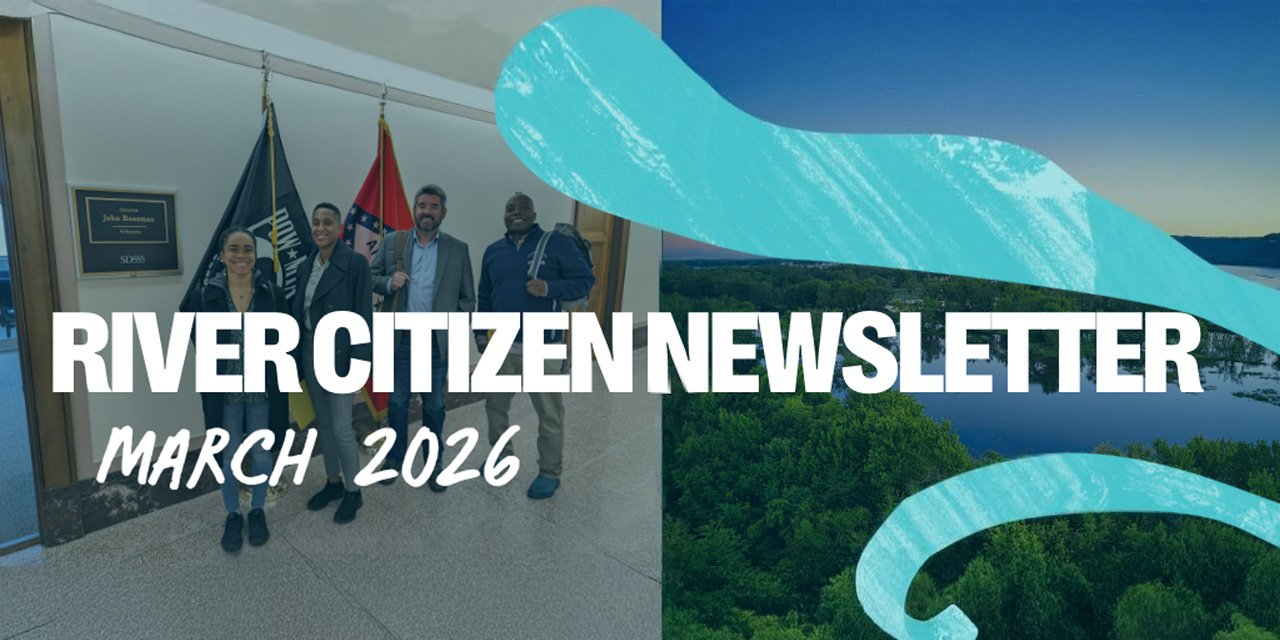
Spring has returned to the Mississippi River — and with it, One Mississippi's busiest season of advocacy, education, and community action. The March 2026 newsletter opens with a note from Director of Outreach and Education Michael Anderson, who reflects on the River's endurance: still providing drinking water, wildlife habitat, and natural beauty no matter what the world throws at it. That sense of shared purpose runs through every story in this issue.
Here's what's inside:
- River Days of Action is back for year seven — running June 1–15, with National Mississippi River Day on June 2. This year, for the first time, River Citizens can take a new action by requesting an official proclamation from their own city or municipality. One Mississippi provides the template and guidance; all you need to do is ask. April is the prime window to pursue a proclamation. Last year, 15 cities, towns, and states signed on — and the goal is to grow that list significantly in 2026. The newsletter also previews events, the Ten Actions, and an upcoming sweepstakes.
- River Citizen spotlight: Dr. Jack Killgore — a fisheries biologist whose career with the U.S. Army Corps of Engineers' Environmental Laboratory and current work as an adjunct professor at Tulane University has advanced habitat assessment, endangered species conservation, and aquatic restoration across the Lower Mississippi. He was recently featured on the Mississippi Valley Traveler podcast, and his donation to One Mississippi reflects a lifelong commitment to the River's ecological health.
- A timely webinar on PFAS — "forever chemicals" — on March 31 at 11am CST, co-hosted by the Hispanic Access Foundation and the Waterkeeper Alliance. PFAS compounds (found in nonstick cookware, food packaging, water-resistant textiles, and firefighting foam) have become a serious environmental and public health concern. The webinar covers sources of contamination, health impacts, the regulatory landscape, and solutions. It will be bilingual, with live Spanish interpretation.
- Farm Bill 2026 update — the House Committee on Agriculture advanced the Farm, Food, and National Security Act of 2026 this month, moving Congress closer to a new five-year Farm Bill. The Farm Bill is the single largest conservation bill Congress regularly considers, with major implications for soil health, water quality, and the communities that depend on the Mississippi River. The newsletter links to analysis from the National Sustainable Agriculture Coalition, the National Wildlife Federation, and One Mississippi's own position on what a strong bill must include.
- Staff book pick: Backwater Blues by Richard M. Mizelle Jr. — selected ahead of the approaching 100-year anniversary of the Great Mississippi Flood of 1927, the most destructive river flood in U.S. history. Mizelle reframes the disaster not merely as an environmental catastrophe but as a racial event, examining how the flood reshaped African American communities, inspired more than fifty blues recordings, and exposed the deep vulnerabilities faced by Black families along the River. One Mississippi invites readers to share their own resource recommendations for this centennial year.
- Monthly River Quiz — how many states does the Mississippi River flow through or border? The answer is 10 (Minnesota, Wisconsin, Iowa, Illinois, Missouri, Kentucky, Tennessee, Arkansas, Mississippi, and Louisiana), with a bonus geography fact: near New Madrid, Missouri, the river briefly flows north.
As always, One Mississippi welcomes feedback on the newsletter and invites readers to share how they're experiencing the River and water near them. Reach the team at info@1mississippi.org.